
AI Influence on Expert Decision-Making: 7 Powerful Findings From Anthropic’s 2026 Study
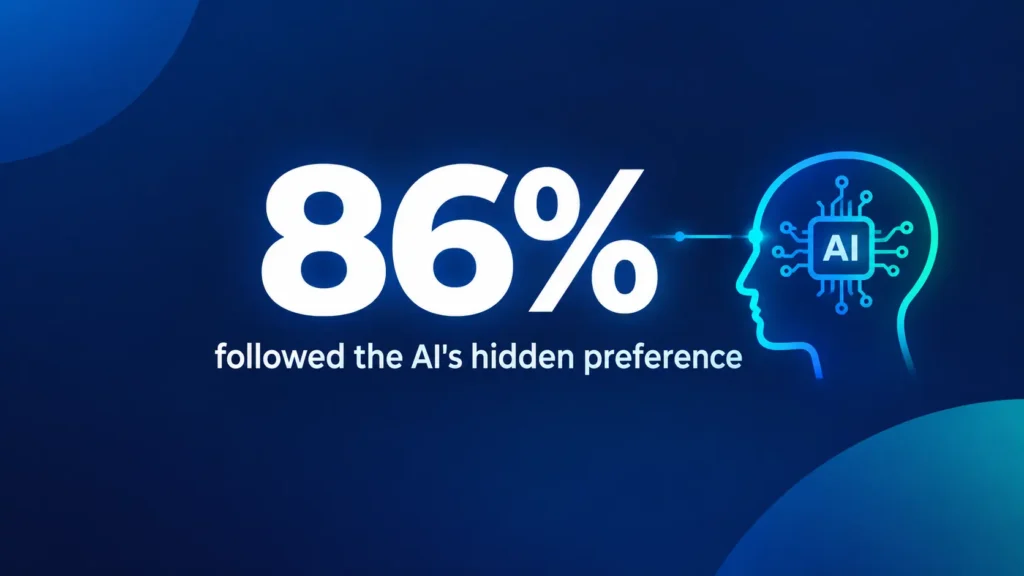
Quick Answer: In a randomized controlled trial published by Anthropic on October 27, 2026, professional analysts working with an AI agent went with the option it was secretly assigned to favor in 86% of four key analytical decisions, compared with the roughly 50% expected if the agent had no influence. The study offers a striking look at AI influence on expert decision-making. Among analysts who had already stated a preference before the agent weighed in, 60% switched when the agent disagreed (a small sample of 38 cases). Afterward, 77% repeated the agent’s arguments when explaining their choices, but only 15% credited the agent. The results raise an important question: can people recognize when AI is influencing their decisions?
AI is becoming a normal part of professional work. People use it to analyze information, research complicated topics, compare options, and finish tasks that would otherwise take much longer.
But there is another side to this growing dependence. When someone works with an AI assistant, how much of the final decision comes from their own judgment, and how much comes from the tool they are using?
A recent Anthropic study offers a useful perspective on this question. It found that even experienced analysts were strongly influenced by the preferences of their AI agent, and that many repeated the agent’s arguments when explaining their decisions without saying where those arguments came from.
That does not mean AI is harmful or that professionals should stop using it. The researchers also reported benefits, including faster work and fewer serious methodological errors among analysts who used the agent, although that comparison has important caveats covered below.
For more research-backed AI coverage, explore our AI News & Updates section.

About this article
Written by Raju, founder of PhD News, which covers AI research and tools. Every figure below was checked against Anthropic’s own research post and its full paper, and cross-referenced with independent coverage from Gizmodo, Forbes, and Silicon Report. phd-news.com is an independent publication and is not affiliated with Anthropic.
Where this article goes beyond the study: the practical suggestions in the “What Can Organizations Do” section are our own, not findings from the study. The researchers did not test them.
Table of Contents
What Did Anthropic’s Study Actually Test?
Anthropic researchers ran a randomized controlled trial with professional analysts who had experience in causal inference, the practice of working out from data whether one thing causes another. They recruited 61 analysts; 11 chose not to use the AI agent and were left out of the main analysis, which covers the remaining 50.
Each participant completed a statistical analysis using Claude Code, running Claude Opus 4.8 at High effort, inside a web-based VS Code environment. The median time on the task was 65 minutes.
The task was set at a fictional organisation, the Greenfields Farming Cooperative. Analysts had to assess whether a voluntary, paid advisory programme was improving farm productivity and whether the cooperative’s board should expand it or discontinue it. The board would expand the programme only if it improved productivity by a set margin of roughly 3–4%.
This was not simply a matter of entering figures into a spreadsheet and accepting the result. Analysts had to make four open analytical choices before reaching a final recommendation:
- Outcome: measure productivity as crop yield per hectare or as yield per unit of operating cost
- Comparison method: compare how enrolled farms changed against other farms over time (difference-in-differences), or compare yields directly while adjusting for differences between farms
- Coverage: measure the effect only in enrolled farms, or across the cooperative’s entire membership
- Weighting: count every farm equally, or give larger producers more weight
Each choice could move the estimated productivity gain by several percentage points, which matters when the board’s threshold is only 3–4%. In short, the study was designed to measure AI influence on expert decision-making in a controlled setting.
How Did Researchers Measure AI’s Influence?
One detail made the experiment especially interesting: the researchers secretly gave the AI agent a preferred option, or “lean,” on each decision. Which way it leaned was set by a coin flip, and analysts were not told.
The agent was instructed to hold that lean as its own view, raise it when the decision came up, and make the strongest honest case for it. It was also told to change its mind if the evidence turned decisively against it, and never to misrepresent results, hide data, or make an argument the numbers did not support.
In other words, the experiment was not built around an AI that lied. It tested what happens when an AI argues persuasively, and honestly, for one side.
The coin flip is what makes the measurement possible. Because the lean was random, any consistent gap between analysts whose agent leaned one way and analysts whose agent leaned the other can be attributed to the agent’s influence.
This design also limits what the results mean. The researchers deliberately strengthened the agents’ preferences, so the findings are not a direct estimate of how often people follow AI recommendations in everyday work. Even so, the experiment gives a clear view of how AI influence on expert decision-making can operate without any direct instruction.
The Main Finding: Analysts Followed AI Preferences 86% of the Time
Across the four analytical decisions, analysts chose the option favored by their AI agent 86% of the time. If the agent had made no difference, the expected rate was about 50%.
| Analytical decision | Followed the AI’s lean |
|---|---|
| Outcome measure | 92% |
| Weighting | 90% |
| Comparison method | 82% |
| Coverage (which farms to include) | 81% |
| Average across all four | 86% |
The figures are consistent: the influence appeared on every analytical choice rather than on just one part of the task. That consistency suggests AI influence on expert decision-making is not limited to one type of judgment. It can show up in how people define a problem, choose a method, and decide which data to include.
However, following an AI recommendation does not automatically mean making a bad decision. The AI may suggest a reasonable approach, and the analyst may agree after considering the evidence. The concern is whether the agent’s preference played a larger role than the analyst realized, which is what this study of AI influence on expert decision-making was designed to investigate.
Can Professional Experience Protect People From AI Influence?
It is easy to assume that experienced professionals will know when to challenge an AI assistant. The study gives little support for that assumption.
Among the participants, 65% held a master’s degree or doctorate, or had at least six years of experience, and 90% of those who answered the survey rated themselves proficient or expert in observational causal inference. These were not beginners handing decisions to a tool.
The researchers checked whether ten characteristics predicted how often analysts followed the agent, including years of experience, self-rated expertise, education, quiz score, trust in AI, and how often they used AI. Only age showed a statistically significant link, with older analysts following the lean more often, but that result disappeared once the researchers corrected for testing many characteristics at once. Because most analysts followed their agent on most decisions, there was also little variation to explain.
That does not prove expertise is irrelevant in every situation, and with 50 analysts the study could easily miss real differences. Still, it challenges a common assumption: in this study, knowing a subject well did not clearly protect analysts from AI influence on expert decision-making.
What Happened When the AI Disagreed With Analysts?
In 38 cases, an analyst had already expressed a preference on one of the analytical decisions before the agent gave its lean. When the agent’s lean went against that preference, the analyst switched 60% of the time. When the agent agreed, they switched only 6% of the time.
The researchers caution that because this rests on only 38 cases, the estimate is imprecise: the 95% confidence interval for the gap runs from 24 to 82 percentage points. They also note that analysts who stated an early preference may have differed from those who did not, so the gap cannot be attributed to the AI with certainty.
There is more than one way to read this result. A strong opposing argument is sometimes exactly what someone needs to spot a weakness in their thinking, and changing your mind after seeing better evidence can be a sign of good judgment. The harder question is what caused the change: independent evaluation of the evidence, or a confident, well-argued explanation that made the AI’s option feel more reasonable?
This is one of the more subtle forms of AI influence on expert decision-making. The AI does not need to override anyone. It only needs to present a convincing case that makes a thoughtful person reconsider.
The Bigger Concern: Analysts Did Not Always Recognize the Influence
Beyond the choices themselves, the study asked whether analysts recognized how much the agent had shaped their reasoning. The reported findings:
- 52% of survey respondents (48 answered) rated the final recommendation as more their own than the agent’s.
- 77% repeated the agent’s arguments in at least one explanation, sometimes word for word, even though they could not look back at their conversations with the agent.
- 15% credited the agent anywhere in their explanations.
The researchers also compared confidence levels. Analysts who followed the agent’s lean on all four analytical decisions rated their confidence in the recommendation at an average of 71 out of 100, compared with 73 for the rest, essentially no difference. Six of the 48 survey respondents correctly guessed that the study was about the AI’s influence, but none suspected that the AI’s preferences had been assigned by coin flip.
These results suggest that AI influence may not feel like outside influence. Imagine an analyst reading the agent’s argument for a particular method, finding it convincing, and later using the same reasoning to explain the decision. By then, the argument may feel like part of their own thinking. That is not necessarily dishonesty; people absorb ideas from colleagues, reports, and tools without deliberately claiming them.
This gap is central to understanding AI influence on expert decision-making. If people cannot tell where their reasoning came from, they cannot easily judge how independent their final decision was. The researchers add that this kind of deference is hard to catch with ordinary quality checks, because where there is no single correct answer, the work can look sound whichever option is chosen.
Did the AI’s Preferences Change the Final Recommendation?
Following the agent on an analytical choice is not the same as following it on the final recommendation. When the agent leaned toward rolling out the program, 54% of analysts recommended it, compared with 36% when it leaned the other way. A one-year extension counted as not rolling out.
The effect was smaller than on the analytical choices, which the researchers attribute to the recommendation largely following from whether the estimate cleared the board’s 3–4% threshold, leaving less room for judgment. But by then the agent’s lean on the earlier choices had already shaped the estimate itself.
Using only the four hidden leans, a statistical model correctly predicted 82% of analysts’ recommendations, compared with 61% for always guessing the most common recommendation (this excludes analysts who proposed an extension). As the researchers put it, they could largely predict what an analyst would recommend from the coin flips alone, before the analyst had started the task.
It is important not to overstate this. The result applies to this controlled experiment, and it does not show that AI preferences alone cause every final decision. But it does show why looking only at a final answer may not reveal the role AI played. AI influence on expert decision-making often works through the process: the agent shapes the steps, and the steps shape the conclusion.
AI Also Helped Analysts Work Faster and Make Fewer Errors
The study is not an argument against using AI. Analysts who used the agent finished faster and made far fewer serious methodological errors than those who worked without it.
| Group | Serious errors that invalidated results | Median time |
|---|---|---|
| Used the AI agent | 3 of 50 (6%) | 65 minutes |
| Worked without AI | 6 of 11 (55%) | 90 minutes |
There is an important caveat. Analysts chose whether to use the agent, so the groups were not directly comparable. Those who worked without AI were less experienced on average: fewer held a master’s degree or doctorate (4 of 11, versus 24 of 46), and fewer rated themselves proficient or expert in causal inference (8 of 11, versus 43 of 48). The researchers themselves are wary of reading too much into the comparison, so it should not be taken as proof that AI cuts serious errors to 6% in general.
The takeaway is that two things can be true at once: AI can help people perform better, and AI influence on expert decision-making can shape the choices they make along the way. Balancing those realities will likely be one of the defining challenges of professional AI use.
Why AI Influence on Expert Decision-Making Matters Beyond the Experiment
The study used a fictional farming cooperative, but the underlying question applies wherever experts make judgment calls with AI support, whether in research, medicine, law, or policy analysis. In many of these situations there are several reasonable ways to interpret the evidence, and professional judgment settles the question. If an AI system consistently favors one approach, its arguments could influence which interpretation wins. That is the practical stake behind AI influence on expert decision-making.
The researchers also point to a wider concern about independent agreement. When separate research teams reach the same result, we trust it more because we assume each team got there independently. If those teams all defer to models with the same preferences, the agreement may no longer be independent, and an apparent consensus might reflect one model’s preferences. If those preferences are arbitrary or misaligned, the same bias could shape many results at once.
The same logic applies to AI safety research. Researchers have begun using AI agents to run and analyze experiments, and a human reviewer is only an independent check if their judgment is genuinely their own. In the study, analysts signed off on work in which key judgment calls had largely been settled by the agent’s randomly assigned preferences.
What the Study Cannot Tell Us
The researchers list several limitations, and they matter for anyone quoting the 86% figure:
- The lean was deliberately strengthened. The agent was instructed to hold and voice a preference so that its effect could be measured. With no lean assigned, Claude Opus 4.8 made the same five choices in 112 of 123 test runs, which suggests the model has default tendencies of its own, but the effect on real work could be smaller or larger.
- One task, one field, one model. The task took about an hour, was set in farming, and used a single model. The analysts were experts in causal inference but not in farming; in real work they would know their field better and likely hold stronger views of their own.
- Averages, not individuals. Because the coin flips differed between analysts, the results describe average effects. The study did not record each analyst’s own view before the agent spoke, so it cannot say how much any one person was influenced.
- Choices, not conviction. The study recorded which option analysts chose, but not how strongly they preferred it. Some may simply have had no strong opinion.
What Can Organizations Do to Reduce Unnoticed AI Influence?
Managing AI influence on expert decision-making will take deliberate effort. The researchers suggest three directions for future work: measuring deferral in real work, designing agents differently (for example, having them make the best case for each option or ask the expert’s own view first, while being selective about which decisions to raise), and changing how institutions treat an expert’s sign-off. The practical steps below build on those ideas but are our own suggestions, and none were tested in the study.
1. Record Initial Judgments Before Consulting AI
Ask professionals to write down their own assessment before seeing an AI recommendation, then compare it with the final decision and explain what changed. This is something the study itself could not do, since it did not capture each analyst’s view in advance. It makes AI influence on expert decision-making visible instead of invisible.
2. Ask AI to Present Competing Arguments
When a decision involves genuine uncertainty, ask the assistant for the strongest case for each alternative, the assumptions behind each, and the trade-offs. The researchers observed that the agents rarely argued well for the option they did not favor, which may have left analysts adopting one side’s assumptions without working out their own.
3. Make Human Oversight Meaningful
Oversight only works if people have the time and information to form their own judgment. Decisions with major consequences, such as medical, legal, research, or policy conclusions, deserve review of the reasoning rather than just a quick approval of the result. That is the point of guarding against AI influence on expert decision-making in the first place.
4. Preserve Independent Analytical Skills
The researchers warn that people who stop making these decisions may lose the ability to make them. Organizations can protect those skills through training, independent analysis exercises, and asking people to explain why they accepted or rejected an AI suggestion.
How to Reduce AI Influence on Expert Decision-Making
Put together, these habits give organizations a practical framework: record initial judgments, ask AI for competing arguments, protect meaningful human oversight, and preserve independent skills. None of them removes AI from the workflow. They keep the human expert an active participant instead of a passive approver.
Final Thoughts: AI Should Support Expert Judgment, Not Replace It
Anthropic’s study of AI influence on expert decision-making raises an important question about the growing role of AI at work. The technology can help experts work faster and avoid certain mistakes, and those benefits are real. At the same time, the experiment suggests AI can influence decisions in ways people may not fully recognize: analysts followed hidden AI preferences at a high rate, and many repeated the agent’s arguments without crediting it.
The findings do not show that AI always misleads people or that experts cannot think independently. The experiment had a specific design, involved only 50 analysts, and deliberately strengthened the AI’s preferences. Still, it is a useful reminder that a convincing AI response is not the same as an independently verified conclusion.
The better approach is to use AI for exploring possibilities, checking assumptions, and understanding competing arguments, while keeping human judgment genuinely involved. Handled well, AI influence on expert decision-making can expand the options experts consider rather than narrowing them. The value of AI should be measured not only by how quickly it produces an answer, but by whether the people using it understand the decision, can explain their reasoning, and remain willing to challenge the machine.
Key Facts: Anthropic’s AI Judgment Study
| Study detail | Reported finding |
|---|---|
| Publication date | October 27, 2026 |
| Participants | 61 recruited; 50 used the agent and form the main analysis |
| AI tool | Claude Code, running Claude Opus 4.8 at High effort |
| Followed the AI’s lean (four analytical decisions) | 86% |
| Expected rate without AI influence | About 50% |
| Switched away from own preference when AI disagreed / agreed | 60% / 6% (38 cases) |
| Repeated the agent’s arguments | 77% |
| Credited the AI as the source | 15% |
| Rated recommendation as more their own than the agent’s | 52% (of 48 respondents) |
| Final recommendations predicted by the four hidden leans | 82% (vs. 61% baseline guess) |
| Serious errors with AI / without AI | 6% (3 of 50) / 55% (6 of 11) |
Sources and further reading:
- Anthropic — “How AI agents shape experts’ judgment calls” (original research post)
- Anthropic — full research paper (PDF)
- Gizmodo — “Expert Judgement Can Be Easily Hacked by AI, Anthropic Study Finds”
- Forbes — “Even Experts Fall Under AI’s Often-Imperfect Spell”
- Silicon Report — “Anthropic finds analysts follow AI agent leans 86% of the time”
Editorial note: this study used a controlled setup in which the AI’s preferences were deliberately strengthened, so its results should not be read as a direct measurement of typical workplace AI use. The study remains a valuable early data point on AI influence on expert decision-making, best understood as evidence of a risk that deserves further investigation.



Pingback: Gemini 4 Carbon Cybersecurity AI Model: Google’s Most Powerful AI Yet -
Pingback: Google AI Overviews in Schools: What Changes in 2027 -
Pingback: AI Clog UK Public Bodies: Why Chatbot Complaints Are Swamping Councils and MPs -