ChatGPT for Teachers expansion to U.S. school district, Reaching 300,000 Educators
Quick answer: OpenAI’s ChatGPT for Teachers expansion to U.S. school districts, announced August 26, 2026, adds 55 new school systems across 20 states — over 100,000 additional educators. OpenAI now works with 100+ K-12 organizations across 30 states, reaching 300,000+ educators and staff, backed by a new 16-state student data privacy agreement.
When OpenAI first launched ChatGPT for Teachers in 2025, it reached nearly 150,000 teachers and staff across the U.S. The goal was simple: give educators a secure space to explore AI, understand where it actually helps, and shape how it gets used in the classroom.
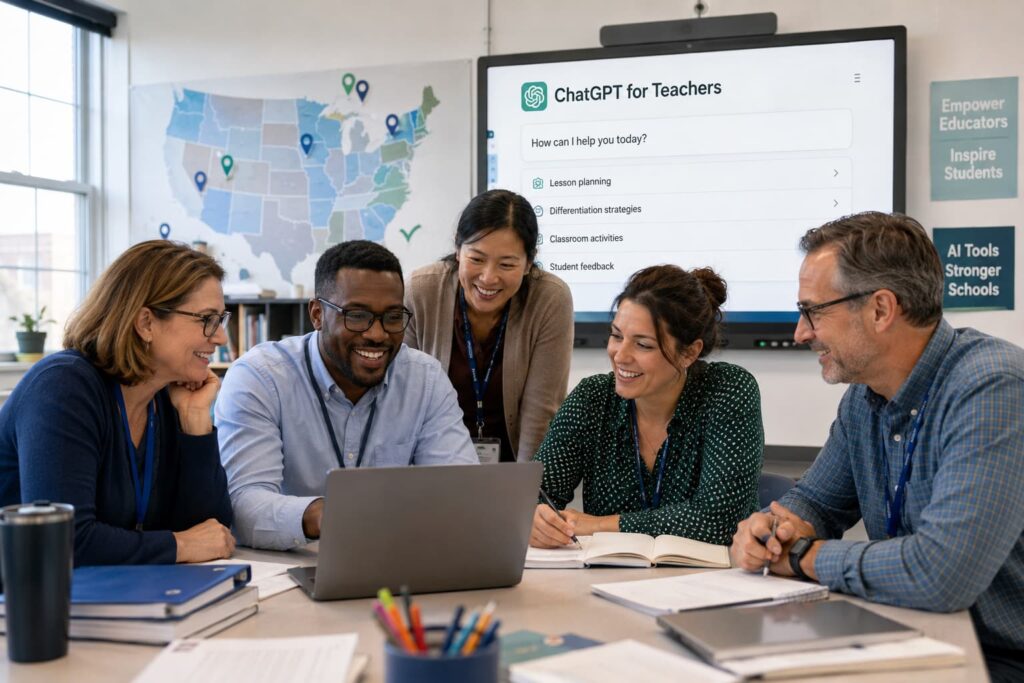
With this latest ChatGPT for Teachers expansion to U.S. school districts, that reach grows again. 55 additional school systems across 20 states are joining, adding more than 100,000 educators and staff. The new cohort includes one in five of America’s 20 largest public school districts, along with several of the country’s most diverse school systems. (Source: OpenAI)
Table of Contents
What Is ChatGPT for Teachers?
ChatGPT for Teachers is a dedicated, education-only version of ChatGPT built for verified K-12 administrators, faculty, and staff — not students. It’s designed with education-grade privacy, security, and administrative controls, and it remains free for verified U.S. K-12 educators through June 2028.
Which States and Districts Have Free Access Now?
This stage of the ChatGPT for Teachers expansion to U.S. school districts takes OpenAI’s total reach to more than 100 K-12 organizations across 30 states, providing free access and training to over 300,000 educators and staff. The expansion isn’t limited to small or rural districts — it reaches some of the largest public school systems in the country, alongside districts known for serving highly diverse student populations.
How Does OpenAI Protect Student Data Privacy?
Alongside the rollout, OpenAI announced a data privacy agreement spanning 16 states — described as a first for the industry. Built through the Student Data Privacy Consortium, this National Data Privacy Agreement gives districts in participating states a recognized path to evaluate and adopt ChatGPT for Teachers without negotiating separate agreements district by district.
The 16 states currently covered are Illinois, Iowa, Maine, Massachusetts, Missouri, Nebraska, New Hampshire, New Jersey, New York, Ohio, Rhode Island, Tennessee, Texas, Vermont, Virginia, and Washington. California is covered through a separate agreement of its own.
On the data-handling side, information shared inside a ChatGPT for Teachers workspace is not used to train OpenAI’s models by default, and school and district leaders can bring educators into a managed workspace with role-based access controls designed to support schools’ FERPA requirements. This is one of the details districts weigh most heavily before signing on to the ChatGPT for Teachers expansion to U.S. school districts.

Real Classroom Impact: The Lynwood Unified Example
Lynwood Unified School District was one of the first to join OpenAI’s original K-12 cohort. Superintendent Patrick Gittisriboongul has framed AI as an equity issue — the goal being to prioritize privacy while giving educators room to explore the tool responsibly.
Through structured training and ongoing peer support, staff there — including librarians, maintenance staff, and administrative personnel, not just classroom teachers — have grown more confident using AI while keeping “the human in the loop,” as one department chair at the district put it.
Tools Teachers Are Actually Using
According to a privacy-preserving analysis OpenAI ran between January 1 and July 16, 2026, educators sent more than 1.9 million messages related to time-saving tasks. That included roughly 900,000 messages about report cards and progress reports, about 800,000 about lesson planning, and more than 100,000 each on substitute plans and teacher-evaluation materials. For more on how AI tools are being used across classrooms and workplaces, check out our AI news and updates section.
Much of this activity, a big part of what makes the ChatGPT for Teachers expansion to U.S. school districts useful day to day, runs through the K-12 Educator plugin, which supports lesson planning, adapting materials, analyzing information, and building classroom resources, all while giving school and district leaders the administrative controls and education-grade privacy protections they need.
What Do Teachers Say About Using ChatGPT in the Classroom?
A few examples from OpenAI’s Academy sessions give a sense of how this plays out day to day: an elementary music teacher in Fairfax built a full planning resource around her curriculum and grading policies; a fourth-grade teacher in Jonesboro used ChatGPT to turn long lesson plans into focused 30-to-40-minute sessions; and a principal in San Bernardino used it to solve a scheduling problem that would otherwise have taken hours.
Training at Scale Through OpenAI Academy
Beyond access, the ChatGPT for Teachers expansion to U.S. school districts comes with ongoing training through OpenAI Academy and the National Academy for AI Instruction, a joint five-year initiative with the American Federation of Teachers aimed at equipping 400,000 K-12 educators with practical AI skills.
This summer, more than 1,600 teachers, administrators, and district leaders took part in hands-on AI Skills Jams hosted by OpenAI Academy in partnership with the Walton Family Foundation, working through real, familiar problems alongside peers and OpenAI mentors.
The feedback has been strong: 93% of participants said they left with something they could use again, and 96% said they planned to apply what they’d learned within 30 days.

New District Partnerships Announced
The latest round of the ChatGPT for Teachers expansion to U.S. school districts includes: Abilene Independent School District (TX), Adlai E. Stevenson High School District 125 (IL), Baltimore City Public Schools (MD), Boise School District (ID), Clarkstown Central School District (NY), El Dorado County Office of Education (CA), Epic Charter Schools (OK), Flagler Schools (FL), Fort Worth Independent School District (TX), Frisco Independent School District (TX), Humble Independent School District (TX), Kern High School District (CA), Killeen Independent School District (TX), Laramie County School District 1 (WY), Lewisville Independent School District (TX), Los Angeles County Office of Education (CA), Needham Public Schools (MA), New Trier Township High School District 203 (IL), Northside Independent School District (TX), Oakland Schools (MI), Orange County Department of Education (CA), Orange County Public Schools (FL), Pocantico Hills Central School District (NY), Rye Country Day School (NY), Santa Cruz County Office of Education (CA), Sarasota County Schools (FL), St. Vrain Valley Schools (CO), Township High School District 211 (IL), Ventura Unified School District (CA), Virginia Beach City Public Schools (VA), and Westminster Public Schools (CO).
Why This Expansion Matters
Put together, this ChatGPT for Teachers expansion to U.S. school districts is one of the largest coordinated AI-adoption efforts in American public education so far. Free educator access, a shared 16-state privacy framework, and structured training all rolled into one push.
For any educator wondering whether it’s worth trying, the access itself isn’t going away soon: ChatGPT for Teachers stays free for verified U.S. K-12 educators through June 2028.