
DeepSeek AI Price Increase: Rates Jump Fourfold Starting Aug. 16, 2026
DeepSeek raised prices for its flagship V4 models by more than four times from August 16, 2026. Peak output pricing for V4.1-Flash rose from $0.28 to $1.20 per million tokens, while V4-Pro increased from $0.87 to $3.96. Even after the change, DeepSeek remains less expensive than some competitors, including Moonshot AI’s Kimi K3.
The DeepSeek AI price increase marks a shift for a company that built its reputation partly on offering powerful AI at unusually low prices. DeepSeek now uses time-based billing, which means the same request can cost more during busy hours and less when demand is lower.
This guide explains what changed, how the current rates compare, when peak pricing applies in India, and what developers can do to keep their bills manageable.
1. What Is the DeepSeek AI Price Increase?
The DeepSeek AI price increase is a pricing change introduced across the company’s V4 model family on August 16, 2026. Rather than charging one fixed rate throughout the day, DeepSeek now applies different prices during peak and off-peak periods.
According to DeepSeek’s published pricing information, off-peak rates are set at half the peak price. That gives developers a way to reduce costs by scheduling work for quieter periods, provided the task does not need an immediate response. Bloomberg reported that some flagship-model rates rose by more than four times under the change.
The DeepSeek AI price increase matters most to businesses and developers that process large volumes of text, run AI agents, generate content, or build products around DeepSeek’s API. For a small project, the extra cost may be manageable. At millions of tokens a day, the difference can become significant.
2. How Much Did DeepSeek’s Prices Rise?
The size of the DeepSeek AI price increase depends on the model, the type of token being processed, and when the request runs. The most visible changes are in peak-hour output pricing.
DeepSeek V4-Flash / V4.1-Flash
- Previous peak output price: $0.28 per million tokens
- New peak output price: $1.20 per million tokens
- Off-peak output price: $0.60 per million tokens
DeepSeek V4-Pro
- Previous peak output price: $0.87 per million tokens
- New peak output price: $3.96 per million tokens
- Off-peak output price: $1.98 per million tokens
Some combinations of token type and billing period reportedly increased by as much as 1,100%. At the same time, 17 hours out of each 24-hour day remain within the off-peak schedule, when the listed rates are half of peak pricing.
3. Current DeepSeek API Pricing
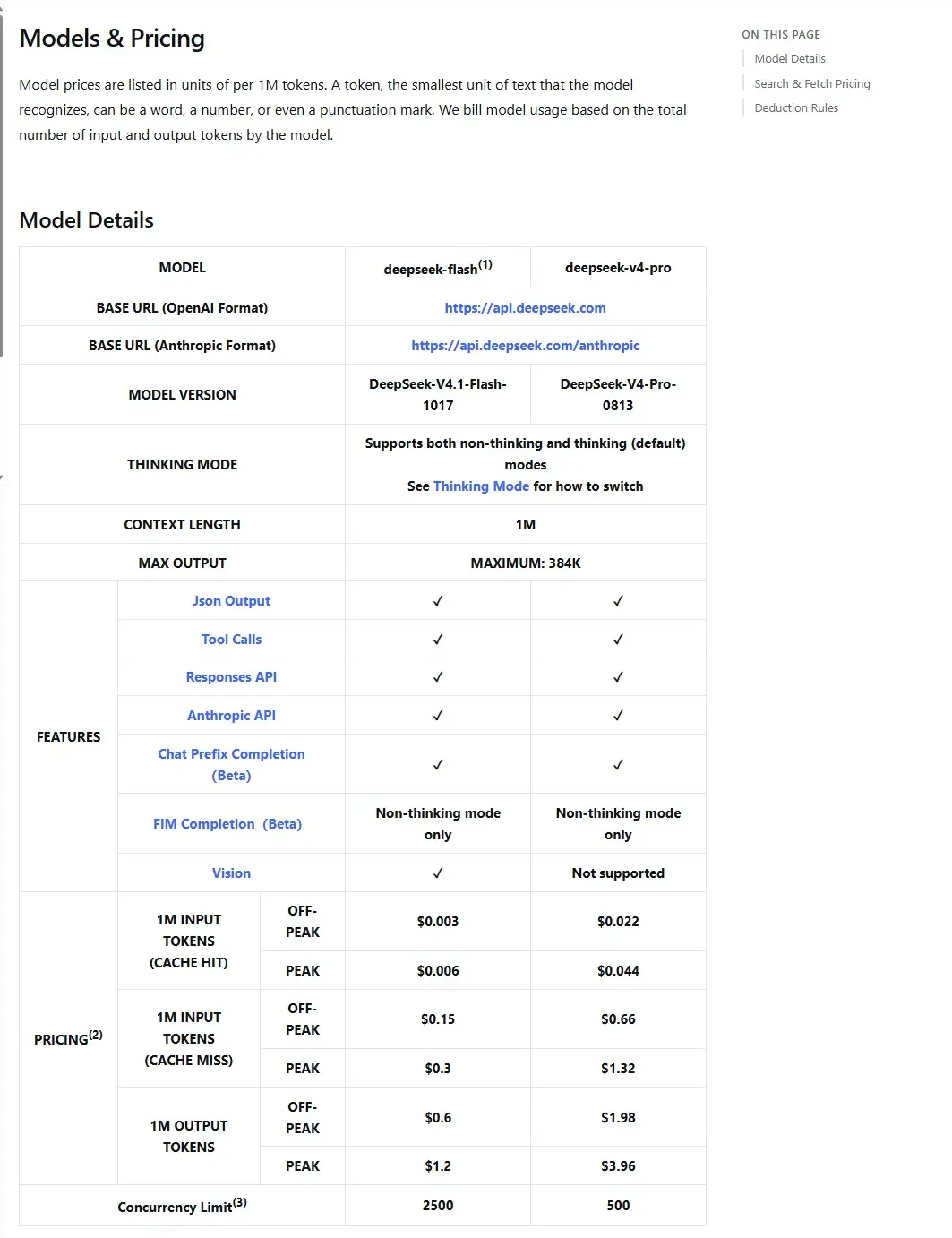
The table below lists the published rates used in this guide, per one million tokens. Cache-hit input refers to input that can be served from the cache; cache-miss input is processed as new input.
| Model | Period | Cache-hit input | Cache-miss input | Output |
|---|---|---|---|---|
DeepSeek V4.1-Flash (deepseek-flash) | Peak | $0.006 | $0.30 | $1.20 |
DeepSeek V4.1-Flash (deepseek-flash) | Off-peak | $0.003 | $0.15 | $0.60 |
DeepSeek V4-Pro (deepseek-v4-pro) | Peak | $0.044 | $1.32 | $3.96 |
DeepSeek V4-Pro (deepseek-v4-pro) | Off-peak | $0.022 | $0.66 | $1.98 |
Source: DeepSeek’s official Models & Pricing documentation. Check the live pricing page before making budget or purchasing decisions.
For a closer look at cache-hit billing, token types, and sample calculations, see our DeepSeek API pricing guide. The exact URL may differ depending on your published article’s permalink.
4. DeepSeek V4.1-Flash Price and Best Uses
V4.1-Flash is DeepSeek’s lower-cost option for many everyday AI tasks. Its API model name is deepseek-flash, and it is intended for workloads where speed and cost matter as much as deep reasoning.
DeepSeek introduced V4.1-Flash on September 10, 2026. On October 17, the hosted model was upgraded to V4.1-Flash-1017, with reported improvements in reasoning, coding, agentic tasks, and visual benchmarks. The API calling method and prices remained unchanged, according to the information provided for this article.
V4.1-Flash rates at a glance
- Peak cache-miss input: $0.30 per million tokens
- Peak output: $1.20 per million tokens
- Off-peak cache-miss input: $0.15 per million tokens
- Off-peak output: $0.60 per million tokens
- Peak cache-hit input: $0.006 per million tokens
- Off-peak cache-hit input: $0.003 per million tokens
When does V4.1-Flash make sense?
It is a practical starting point for chatbots, customer support, content drafting, summarization, translation, data extraction, basic coding assistance, document analysis, and high-volume automated workflows. If a task does not require extensive multi-step reasoning, using the lower-cost model can help control spending.
5. DeepSeek Peak Hours in India (IST)
DeepSeek’s listed peak periods are 01:00–04:00 UTC and 06:00–10:00 UTC from Monday to Friday, excluding Chinese public holidays. Converted to Indian Standard Time, those windows are approximately 6:30–9:30 AM and 11:30 AM–3:30 PM.
| UTC schedule | Approximate IST | Rate period |
|---|---|---|
| 01:00–04:00 UTC | 6:30–9:30 AM | Peak |
| 06:00–10:00 UTC | 11:30 AM–3:30 PM | Peak |
| Other weekday hours | All remaining hours | Off-peak |
| Saturday and Sunday | All day | Off-peak |
For developers in India, this schedule creates an opportunity to move non-urgent work outside the two peak windows. Bulk content generation, document summaries, data extraction, translation, and background reports can often run later in the day, overnight, or on weekends. Real-time customer support and interactive applications may still need to run immediately, even when peak prices apply.
6. DeepSeek API Cost Calculator: Practical Examples
To estimate output costs, divide the number of output tokens by one million and multiply by the relevant output rate. These examples exclude input tokens and any Search or Fetch API charges.
| Output volume | V4.1-Flash peak | V4.1-Flash off-peak | V4-Pro peak | V4-Pro off-peak |
|---|---|---|---|---|
| 1 million tokens | $1.20 | $0.60 | $3.96 | $1.98 |
| 10 million tokens | $12 | $6 | $39.60 | $19.80 |
| 50 million tokens | $60 | $30 | $198 | $99 |
For example, generating 10 million output tokens with V4.1-Flash costs about $12 during peak hours or $6 off-peak. The same output volume with V4-Pro costs $39.60 at peak or $19.80 off-peak. Your actual bill will also reflect regular input tokens, cached input, and any separately billed API requests.
7. Search and Fetch API Pricing
DeepSeek’s Search and Fetch APIs are listed at $0.75 per 1,000 successful requests for each endpoint. Failed requests, empty results, and timeouts are not billed under the pricing details supplied for this article.
Server-side Search and Fetch calls made through DeepSeek Harness, Claude Code, and Codex are described as free until October 31, 2026. Per-request billing is scheduled to begin at 00:00 Beijing time on November 1, 2026. Teams that depend on these tools should review their request volume and update cost estimates before that date.
8. Why Is DeepSeek Raising Prices Now?
The DeepSeek AI price increase comes as the company expands its model lineup and handles more demanding workloads. The price change followed the release of V4-Pro, described as a 1.6-trillion-parameter mixture-of-experts model aimed at coding agents and complex autonomous tasks, alongside improvements to V4-Flash.
Several factors may help explain the change:
- Demand is growing: Higher usage creates more pressure on available computing capacity.
- Infrastructure is expensive: Training and serving large models require data centers, advanced chips, power, and ongoing engineering investment.
- V4-Pro targets demanding work: Complex reasoning and agent workflows can require more resources than routine chat or summarization.
- Investor attention is increasing: The company is reportedly raising substantial capital and preparing for a possible public listing.
Bloomberg reported that the pricing change was announced ahead of a potential IPO and that some rates increased by more than four times. These points provide context, but they should not be treated as confirmation of a single official explanation for the new prices.
9. Is DeepSeek Still Cheaper Than Its Competitors?
Yes, based on the rates cited in reports, DeepSeek remains cheaper than some competitors even after the increase. V4-Pro’s peak output rate is $3.96 per million tokens, compared with a reported rate of about $15 per million output tokens for Moonshot AI’s Kimi K3.
Bloomberg also noted that the earlier V4-Flash rates were $0.14 per million input tokens and $0.28 per million output tokens, while Kimi K3 was reported at $3 and $15 respectively. The new pricing reduces DeepSeek’s cost advantage, but does not remove it in this comparison.
Price alone does not tell the whole story. Model quality, reliability, response speed, context requirements, caching, and the type of task all matter. Developers should test the models on their own workloads before deciding which one offers the best overall value.
10. DeepSeek’s Funding Round and Shanghai IPO Plans

The DeepSeek AI price increase is taking place alongside a major reported funding round and preparations for a possible stock-market listing.
Latest funding round
Reuters reported on October 22, 2026, that DeepSeek raised about 100 billion yuan, or $14.98 billion, in its latest funding round. Reported investors include GigaDevice, Meituan, Geely, Tencent, CATL, Legend Capital, and Shixi Capital. The round reportedly came about four months after a $7.4 billion raise in June 2026.
U.S. restrictions
Two days before the funding report, the U.S. ordered federal civilian agencies to remove DeepSeek’s AI technology from their systems over security concerns. The reported funding close despite those restrictions suggests that domestic investors remain interested in the company, though it does not settle questions about how the restrictions may affect its international business.
Possible IPO
DeepSeek has reportedly hired CITIC Securities to prepare for a potential IPO on Shanghai’s STAR Market, an exchange focused on technology and growth companies. A listing application could be filed as early as the end of 2026, with a possible public listing in 2027. The timetable remains uncertain and depends on regulatory approval.
11. DeepSeek DeepInfer and Its Huawei Partnership
DeepSeek is also working to reduce its reliance on Nvidia’s software and hardware ecosystem. On October 20, 2026, the company open-sourced DeepInfer, an inference framework used to run large-scale AI services. The project is available on GitHub under the Apache 2.0 license and is described as supporting Nvidia Blackwell GPUs as well as Huawei Ascend 950 NPUs.
DeepSeek has also partnered with Huawei on programming tools for Ascend chips. The reported work includes compute and communication libraries and a “supernode” design built around 128 Ascend 950 chips. The effort could give DeepSeek more options for deploying its models across different hardware platforms.
12. Approval for Overseas Model Deployment
Chinese state media reported that DeepSeek and MiniMax completed registration and received approval to open-source and deploy AI models overseas under proposed export controls. The development points to Beijing allowing some leading domestic AI companies to expand internationally under a regulatory framework.
For DeepSeek, overseas deployment could create more opportunities to serve developers and businesses outside China. The practical impact will depend on how the rules are implemented and how customers in different markets respond to security, compliance, and procurement requirements.
13. What the Price Increase Means for the Global AI Market
DeepSeek’s low prices helped put pressure on the AI industry to reconsider how much it costs to train and run advanced models. Its earlier pricing made it an attractive alternative for developers looking to build AI-powered products without paying premium rates for every request.
The DeepSeek AI price increase is a reminder that serving popular models at scale has real costs. As demand rises and systems take on more complex tasks, even a provider known for aggressive pricing may need to adjust its rates. For developers, the answer is not simply to abandon a model, but to match the model to the job.
Use V4.1-Flash for routine tasks and reserve V4-Pro for work that genuinely benefits from stronger reasoning. Schedule flexible jobs off-peak, make use of prompt caching, limit unnecessary output, and monitor spending by task. These steps can help keep costs predictable even when rates change.
14. DeepSeek AI Price Increase: Key Facts
| Detail | Update |
|---|---|
| Price change effective | August 16, 2026 |
| V4.1-Flash peak pricing | $0.30 input / $1.20 output per million tokens |
| V4.1-Flash off-peak | $0.15 input / $0.60 output per million tokens |
| V4-Pro peak pricing | $1.32 input / $3.96 output per million tokens |
| V4-Pro off-peak | $0.66 input / $1.98 output per million tokens |
| Maximum reported increase | Up to 1,100% for some rate combinations |
| Off-peak discount | 50% below peak rates |
| Peak hours | 01:00–04:00 and 06:00–10:00 UTC, Monday–Friday |
| Search and Fetch APIs | $0.75 per 1,000 successful requests per endpoint |
| Latest reported funding | About $14.98 billion, October 22, 2026 |
| U.S. restrictions reported | Federal civilian agencies ordered to remove DeepSeek technology, October 20, 2026 |
| DeepInfer release | Open-sourced October 20, 2026 |
| Huawei partnership | Tools for Ascend chips and reported 128-chip supernode |
| Possible IPO | Shanghai STAR Market; potential filing late 2026 and listing in 2027 |
| Competitor comparison | Kimi K3 reported at about $15 per million output tokens |
15. Frequently Asked Questions
When did the DeepSeek AI price increase take effect?
The DeepSeek AI price increase took effect on August 16, 2026, according to the information cited in this article.
How much did DeepSeek raise its prices?
Some flagship-model peak output rates increased by more than four times. Certain combinations of token type and billing period reportedly rose by as much as 1,100%.
Is DeepSeek still cheaper than other AI companies?
It remains cheaper than some competitors on the cited output-token comparison. For example, V4-Pro is listed at $3.96 per million output tokens at peak, compared with a reported $15 for Kimi K3. Rates and capabilities should be compared model by model.
Is DeepSeek planning to go public?
Reports say the company has hired CITIC Securities to prepare for a possible IPO on Shanghai’s STAR Market. A listing in 2027 has been discussed, but the schedule is not confirmed.
How much funding has DeepSeek raised?
Reuters reported a funding round of about $14.98 billion on October 22, 2026. The company had reportedly raised about $7.4 billion in June 2026.
Why is DeepSeek increasing its AI prices?
Growing demand, the cost of running large models, the launch of more capable models, and the company’s fundraising and IPO plans form the broader context. The available reports do not establish one single official reason for the price change.
How can developers pay less for DeepSeek API usage?
Choose V4.1-Flash for routine tasks, schedule flexible jobs during off-peak hours, use caching for repeated prompts, limit response length, and track token consumption by workflow.
Sources
- DeepSeek API Docs — Models & Pricing — official published rates
- DeepSeek API documentation and change log — model and pricing updates
- Bloomberg — DeepSeek increases prices for AI services — reported pricing change
- Reuters — DeepSeek fundraising report — latest funding update
- TechCrunch — DeepSeek funding and U.S. restrictions — policy and funding context
- GitHub — DeepInfer repository — open-source project
- Business Standard — DeepSeek and Huawei partnership — Ascend chip tools
- The Edge Malaysia — overseas model deployment approval — global deployment report
Editorial note: AI pricing and policy announcements can change quickly. Confirm current rates in DeepSeek’s official API documentation before making purchasing or development decisions.

Pingback: DeepSeek API Pricing: Avoid Costly Mistakes With V4.1-Flash & V4-Pro