
NVIDIA AVO ARC-AGI-3 Reaches 100% With Frontier-Level General-Purpose AI Architecture Built for Long-Horizon Autonomous Agents and Advanced Reasoning
NVIDIA AVO ARC-AGI-3 is the story everyone in the agentic AI space is talking about this week. Every few months, there’s an AI benchmark result that makes people in the field stop scrolling for a second. This is one of those. NVIDIA just published results showing that its research architecture, called AVO (Agentic Variation Operators), achieved a perfect 100.00 RHAE score on ARC-AGI-3 — a benchmark specifically built to be hard for AI agents to game. And the part that’s raising eyebrows isn’t just the score. It’s how they got there.
Quick Answer: NVIDIA’s AVO (Agentic Variation Operators) architecture achieved a 100.00 RHAE score on ARC-AGI-3, completing all 183 levels across 25 environments with 12% fewer environment actions than VISTA. AVO uses an unmodified Claude Opus 5 model wrapped in persistent memory, supervision, and tool-use — showing that the gain comes from system-level architecture, not a bigger or fine-tuned model.
- Architecture name: Agentic Variation Operators (AVO), developed by NVIDIA
- Benchmark: ARC-AGI-3 (25 environments, 183 levels total)
- Score achieved: 100.00 RHAE, 12% fewer environment actions than VISTA
- Base model used: Claude Opus 5 (off-the-shelf, not fine-tuned)
- GPU-kernel optimization result: up to 10.5% faster than FlashAttention-4 on NVIDIA DGX B200 systems
- GPU-kernel search scale: 500+ directions explored, 40 kernel versions committed
They didn’t train a new model. They didn’t fine-tune anything for the test. They took Claude Opus 5, an off-the-shelf model available to anyone, wrapped it in NVIDIA’s AVO architecture, and let the system’s memory, supervision, and tool-use layers do the heavy lifting. Same base model, dramatically different outcome — and that gap is really the whole story here.
Table of Contents
NVIDIA AVO ARC-AGI-3: What Actually Is AVO?
AVO — Agentic Variation Operators — is a general-purpose agent architecture built by NVIDIA that enables sustained autonomous operation on long-horizon tasks by integrating persistent memory, supervision, and tool-use within a single general-purpose system, rather than relying on a task-specific fine-tuned model. Think of it less like a chatbot and more like a very disciplined, very patient engineer who never gets tired of trying again and never forgets what didn’t work last time.
What’s interesting is that NVIDIA didn’t build AVO to be good at one specific thing. A lot of AI systems get really good at one narrow benchmark and then fall apart the moment you point them at something different. AVO was built the opposite way — around a general search-and-refine loop that can, in theory, be pointed at almost any problem where you can define “better” and “worse” attempts. That design choice is what let the same system work on two wildly different problems: squeezing extra performance out of GPU code, and solving abstract reasoning puzzles it had never seen before.
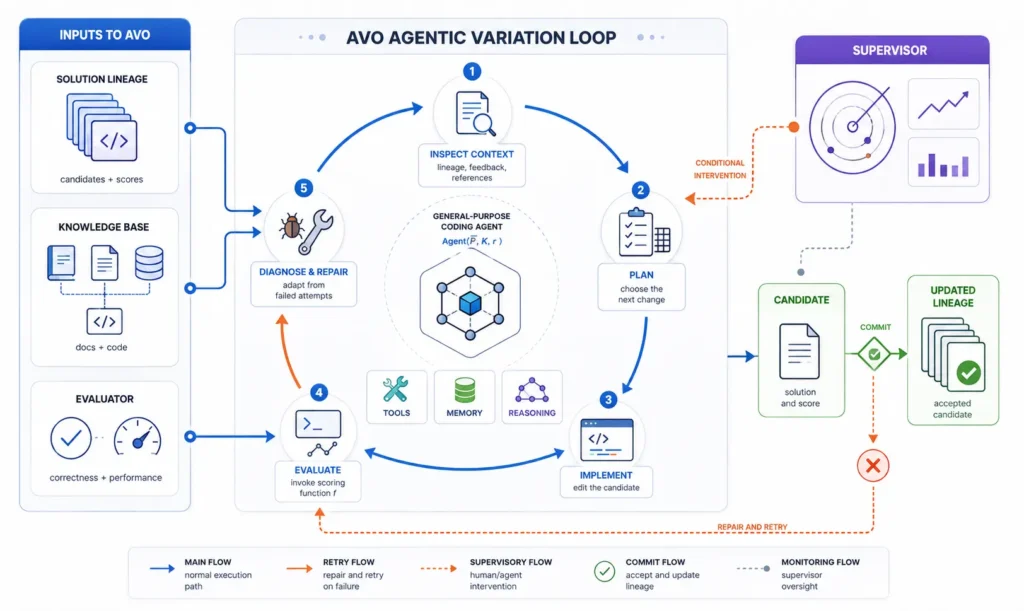
Image generated using AI
First Test: Making GPUs Faster
Before ARC-AGI-3 ever came into the picture, NVIDIA put AVO to work on something a lot less abstract and a lot more brutal — GPU kernel optimization. If you’ve ever talked to someone who writes low-level GPU code for a living, you know this is not a forgiving field. One wrong assumption about memory layout or thread scheduling and your “optimized” code is either slower than before or just plain wrong.
Running on NVIDIA DGX B200 systems, AVO autonomously explored more than 500 different optimization directions and committed 40 distinct kernel versions along the way. The best of those kernels ended up running up to 10.5% faster than FlashAttention-4 — a widely used, heavily hand-optimized reference implementation. That’s not a small thing. Matching or beating a reference kernel that engineers spend months hand-tuning is a genuinely notable result for a fully autonomous system, and it shows AVO running a productive engineering loop — propose, test, measure, refine — entirely without manual intervention.
The Secret Ingredient: It Doesn’t Forget
Here’s something that’s easy to skim past but is actually central to why this works. Most AI agent setups reset with every new context window — they lose the thread of what they tried before, what failed, and why. AVO doesn’t. It carries memory forward across the entire run: past attempts, evaluation scores, compiler errors, profiler output, all of it. It’s the difference between someone solving a puzzle fresh every five minutes versus someone who remembers every dead end they’ve already ruled out.
There’s also a kind of built-in “coach” watching the process — a supervisor layer that notices when the agent is stuck in a loop, repeating the same unproductive move over and over, and nudges it toward a different strategy. Anyone who’s ever watched an AI agent get stuck repeating the same failed fix five times in a row will understand why that matters.
Then Came the Real Stress Test: NVIDIA AVO ARC-AGI-3
Once AVO had proven itself on GPU code, NVIDIA wanted to know something harder to answer: does this actually generalize, or did it just get lucky on one very specific type of problem? That’s where the NVIDIA AVO ARC-AGI-3 benchmark run comes in.
If you’re not familiar with it, ARC-AGI-3 is intentionally nasty for AI systems. It drops an agent into game-like environments with no instructions, no stated rules, and no explicit goal. You’re expected to figure out what you’re even supposed to be doing just by poking around and observing what happens — the same way a curious kid might approach an unfamiliar video game with no manual. It’s designed to punish agents that only work well when everything is spelled out for them.
AVO completed all 183 levels across all 25 environments in the ARC-AGI-3 evaluation set, landing a perfect 100.00 RHAE (Relative Human-Action Efficiency) score — and it did it using 12% fewer environment actions than VISTA, another strong agent system used as a comparison point. That last part matters more than it might look at first glance.
A perfect completion score on its own can be misleading — an agent that brute-forces its way through every possible action will eventually stumble into the right answer too. RHAE is designed to catch exactly that by measuring efficiency, not just success. Beating VISTA by 12% fewer actions while still hitting a flawless completion score means AVO wasn’t guessing its way through — it was reasoning its way through, closer to how a human would actually approach an unfamiliar puzzle.
You can see the full leaderboard and rules for the benchmark itself on the official ARC Prize website, and NVIDIA’s original write-up of the NVIDIA AVO ARC-AGI-3 run is published on the NVIDIA Developer Technical Blog.

Image generated using AI
Why This Matters More Than the Number Itself
Honestly, the perfect score is a nice headline, but it’s not really the point. The real takeaway NVIDIA seems to be making is quieter and more interesting: the same agent architecture, first proven on something as narrow and mechanical as GPU kernel tuning, carried over almost directly into a completely different kind of reasoning problem. Nobody rebuilt AVO from scratch for ARC-AGI-3. They pointed the same system at a new problem and it just worked — which is strong evidence that performance and generality in agent systems come from system-level architecture, not from model-level capability alone.
That’s a meaningful signal for where agentic AI is actually heading. For a while now, a lot of the industry’s energy has gone into training bigger and better base models. This result is a reminder that the model is only part of the equation — how you build memory, feedback loops, supervision, and tool-use around that model can matter just as much, sometimes more, than which model you’re using underneath.
What Comes Next
NVIDIA’s own framing is that this isn’t the finish line — it’s proof that the direction is worth pushing further. The team is now looking at scaling this general-purpose agentic approach even more, aiming for agents that can identify their own promising directions and get better at their own process over long stretches of work, without needing a human to hand-design the reward signal every step of the way.
If that pans out, the gap between “an AI that can follow instructions well” and “an AI that can actually figure things out on its own” is going to keep shrinking. And based on this result, NVIDIA seems to think that gap is closing faster than a lot of people expected.
Frequently Asked Questions: NVIDIA AVO ARC-AGI-3
What is NVIDIA AVO?
AVO stands for Agentic Variation Operators — a general-purpose agent architecture developed by NVIDIA that enables sustained autonomous operation on long-horizon tasks through persistent memory, supervision, and tool-use, without relying on a task-specific fine-tuned model.
What score did NVIDIA AVO get on ARC-AGI-3?
AVO achieved a 100.00 RHAE score, completing all 183 levels across 25 environments in the ARC-AGI-3 benchmark, using 12% fewer environment actions than VISTA.
Which AI model powers NVIDIA AVO?
AVO used an unmodified, off-the-shelf Claude Opus 5 model — no fine-tuning or custom training was applied for the ARC-AGI-3 run.
What did AVO achieve in GPU-kernel optimization?
AVO autonomously explored over 500 optimization directions, committed 40 kernel versions, and reached kernels up to 10.5% faster than FlashAttention-4 on NVIDIA DGX B200 systems.
What is ARC-AGI-3?
ARC-AGI-3 is an interactive reasoning benchmark that places an AI agent in unfamiliar game-like environments with no explicit instructions, rules, or stated goals, testing its ability to figure things out through observation and trial.
What is Relative Human-Action Efficiency (RHAE)?
RHAE is a metric that measures how efficiently an agent solves a task relative to a baseline or comparison system — in AVO’s case, versus VISTA — rewarding smart, reasoned problem-solving over brute-force trial and error.
That’s the full NVIDIA AVO ARC-AGI-3 story for now — worth bookmarking, because this is likely the first of several updates as NVIDIA scales the approach further. For more breakdowns like this, check out our AI & Technology section.
Source: NVIDIA Developer Technical Blog
Image disclosure: All images used in this article are AI-generated and created for illustrative purposes only.
A note on responsible AI use: NVIDIA is committed to safety, trust, and transparency in AI development. NVIDIA encourages developers to ensure any product or service built on its technology meets the legal and ethical standards of its industry, to take reasonable steps to identify and reduce unintended bias and harm — particularly to underrepresented or vulnerable groups — and to clearly inform users of the capabilities and limitations of what they build. NVIDIA’s technology is not to be used for illegal surveillance, unlawful collection or processing of biometric data without consent, or for harassment, abuse, threats, or intentionally misleading or deceiving others.