
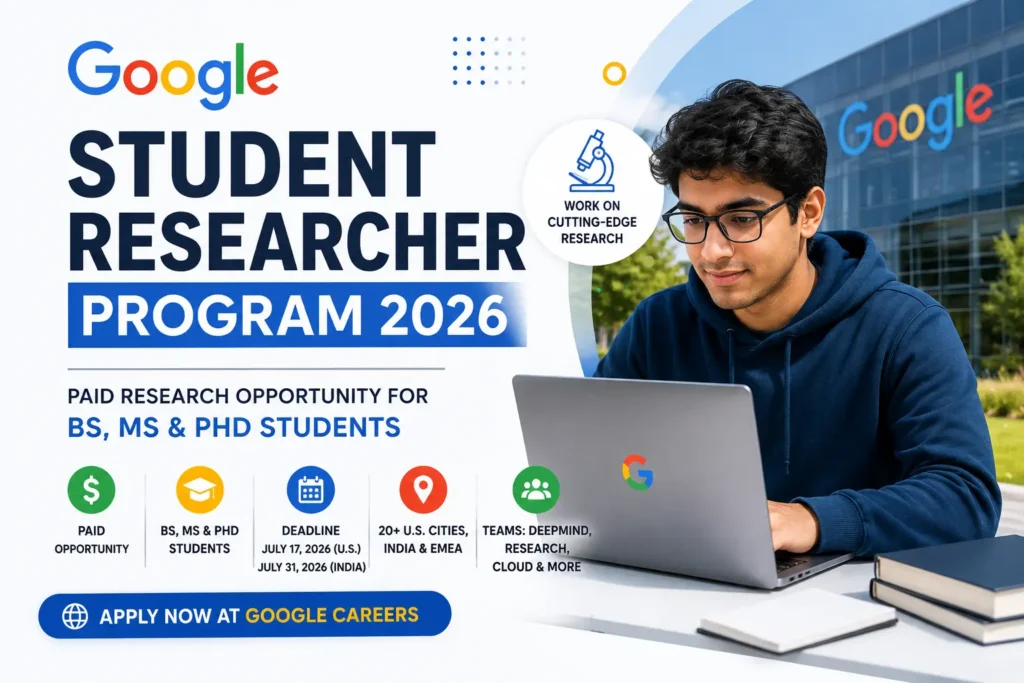
Google Student Researcher Program 2026: Apply Now, Eligibility & Salary
Quick Answer
The Google Student Researcher Program is a paid research opportunity for BS, MS, and PhD students in Computer Science, Linguistics, Statistics, Applied Mathematics, and related technical fields. Google posts new openings on a rolling basis throughout the year across the US, India, and EMEA — the most recent 2026 cycle’s US deadline (July 17) and India deadline (July 31) have now closed, but Google typically reopens new listings for the next intake. Apply directly at Google Careers.
Table of Contents
⚠️ Current Application Status (Important)
If you’re reading this after July 2026, the deadlines listed for the most recent cycle have already passed. Here’s what that means for you:
- US & India cycles for 2026 are closed as of this update
- Google’s Student Researcher listings reopen on a rolling basis — new postings for the next intake (often Winter/Summer cycles) typically appear on Google Careers a few months ahead of each new window
- Bookmark this page — we update it as soon as new listings and deadlines are confirmed, so you don’t miss the next window
What Is the Google Student Researcher Program?
Unlike a traditional Google internship, this official paid research program focuses on open-ended, exploratory scientific advancement rather than a fixed product deliverable. You work directly with Google’s research teams, and when you apply, Google automatically considers you for relevant positions across their research organization — including Google DeepMind, Google Research, and Google Cloud — to match your skills and interests.
This makes it a strong fit for students passionate about machine learning, algorithmic optimization, and theoretical computer science who want research depth over a traditional software engineering internship. If you’re weighing this against other paid opportunities, it’s worth comparing it with other scholarship and fellowship programs covered here.
Google Student Researcher Program: Recent Deadlines (For Reference)
| Location | Eligible Degrees | Most Recent Deadline | Duration |
|---|---|---|---|
| United States (San Francisco, NY, and 20+ cities) | BS, MS, PhD | July 17, 2026 (closed) | 12–24 Weeks |
| India (Bengaluru) | BS, MS, PhD | July 31, 2026 (closed) | 12–24 Weeks |
| EMEA (Select Countries) | BS, MS, PhD | Varies by country | 12–24 Weeks |
Note: The program runs on a rolling basis with a minimum time commitment of four days a week, in-person at a Google office. New cycles are typically announced with several months’ notice — check back here for the next confirmed window.
Student Researcher Google Salary & Benefits
Is the program paid? Yes — this is a fully compensated research role, not an unpaid internship. Based on publicly reported figures from recent cycles, PhD-level student researchers in the US have earned in the range of $118,000–$157,000 annualized, with BS/MS roles compensated at a competitive hourly rate. Compensation varies by location, degree level, and role.
- US Locations: Competitive hourly pay, with corporate housing or a housing stipend offered for the duration of the program in many cases
- India Locations: A monthly stipend aligned with top-tier research positions in the country
- Additional Perks: Hands-on experience on real-world, large-scale research problems, direct collaboration with world-leading scientists, and the possibility of co-authoring published research papers
Google Student Researcher PhD 2026: What’s Different
If you’re specifically searching for the Google Student Researcher PhD track, here’s what sets it apart from the BS/MS listings:
- Separate job listing: PhD candidates apply through a dedicated “Student Researcher, PhD” posting on Google Careers — distinct from the BS/MS listing, even though the core program structure is the same
- Research depth expected: PhD applicants are generally expected to have deeper research experience — published papers, conference presentations, or significant lab work — since projects at this level tend to be more advanced and publication-focused
- Compensation: PhD-level student researchers in the US have reported annualized compensation in the range of $118,000–$157,000, generally higher than BS/MS rates, reflecting the seniority of the research work
- Duration & commitment: Same as other tracks — 12–24 weeks, minimum four days a week, in-person at a Google office
- Return-to-program requirement: Like BS/MS applicants, PhD students must be returning to their doctoral program after the engagement — this is not a path to full-time conversion
Where to find the PhD listing: Search “Student Researcher, PhD” directly on Google Careers — it’s listed separately by season (e.g., “Student Researcher, PhD, Winter/Summer 2026”) rather than as a single year-round posting.
Google DeepMind Student Researcher Program
Applicants with a strong background in neural networks, NLP, or reinforcement learning may be matched with the Google DeepMind Student Researcher track. This places you alongside some of the field’s leading AI scientists working on frontier research problems. Candidates with published papers or strong open-source contributions tend to have stronger odds of being matched with DeepMind-aligned projects, though matching depends entirely on host team needs each cycle.
Google Student Researcher Program 2026: India
For applicants in India, the program requires you to be physically located in India (typically Bengaluru) for the full duration of the engagement. Required documents include an updated CV/resume with your expected graduation date (MM/YY) and programming language proficiencies, plus a current academic transcript in English (PDF preferred). India-specific deadlines are announced separately from the US cycle — check the current listing status above.
Eligibility Criteria (BS, MS, and PhD)
To be eligible, applicants must meet these requirements:
- Currently enrolled full-time in a Bachelor’s, Master’s, or PhD program in Computer Science, Linguistics, Statistics, Biostatistics, Applied Mathematics, Operations Research, Economics, Natural Sciences, or a related technical field
- Must be returning to your degree program after completing the research engagement (this program is not conversion-eligible)
- Must be physically located in the country of the role for the full 12–24 week duration
- Experience with at least one general-purpose programming language (Python, Java, C/C++, JavaScript)
- English proficiency required — your academic transcript serves as proof; IELTS is not needed
Bonus (Preferred, Not Mandatory):
- Published research papers in major conferences or journals
- Prior research experience — internships, lab work, or full-time research roles
- Contributions to open-source projects or academic research communities
What to Expect If You’re Shortlisted
If your application moves forward, Google’s research teams review candidates based on fit with their specific ongoing projects — this is sometimes called host matching, where your profile is shared with the research scientist leading a project that aligns with your background. From there, expect one or more conversations focused on your technical background, past research or coursework, and how you think through open-ended problems — this tends to differ from a standard software engineering interview, which leans more heavily on live coding.
Specific interview formats vary by team and haven’t been publicly standardized by Google, so the best preparation is a strong, clearly documented research background rather than memorized interview questions. If you look for Google Student Researcher discussions on Reddit or other student forums, treat individual applicant experiences as anecdotal — Google hasn’t published an official interview rubric, so no single account fully represents the process.
How to Apply (Step-by-Step)
- Visit the Portal: Go to careers.google.com and search for “Student Researcher”
- Select Your Role: Choose the listing matching your region and degree level (e.g., Student Researcher, BS/MS or Student Researcher, PhD)
- Prepare Documents: Ensure your CV clearly states your expected graduation date (MM/YY) and programming languages; have your current English transcript ready (PDF preferred)
- Submit Application: In the Education section, select “Now attending” to correctly upload your transcript, and submit before the listed deadline for your chosen role
Frequently Asked Questions
Is this different from a Google internship? Yes. While similar in structure, the Student Researcher role is focused on academic-style, open-ended research and potential publication, whereas a standard software engineering internship focuses on building specific product features.
Can international students apply? Yes, the program is global — but you must apply to the listing for the specific country where you can legally reside and work for the entire duration, and remain there throughout the engagement.
Do I need an IELTS score? No. Your English-language academic transcript is sufficient proof of language proficiency.
Is the Google Student Researcher Program 2026 paid? Yes — it’s a fully compensated position with pay that varies by location and degree level.
When does the next cycle open? Google typically posts new Student Researcher listings a few months before each new intake window. Check the current status section at the top of this article for the latest confirmed dates.
How is the Google Student Researcher PhD track different from BS/MS? PhD applicants apply to a separate listing and are generally expected to bring deeper research experience, such as published papers or significant lab work. Compensation also tends to be higher for PhD-level roles, but the core program structure — duration, location requirement, and return-to-program rule — is the same across all degree levels.
Follow PHD-News for daily scholarship and career opportunity updates. Explore more paid research and fellowship opportunities in our Job & Careers section.