Trump Overseas Data Center Ban: What He Said, What’s Unclear, and Who Could Be Affected
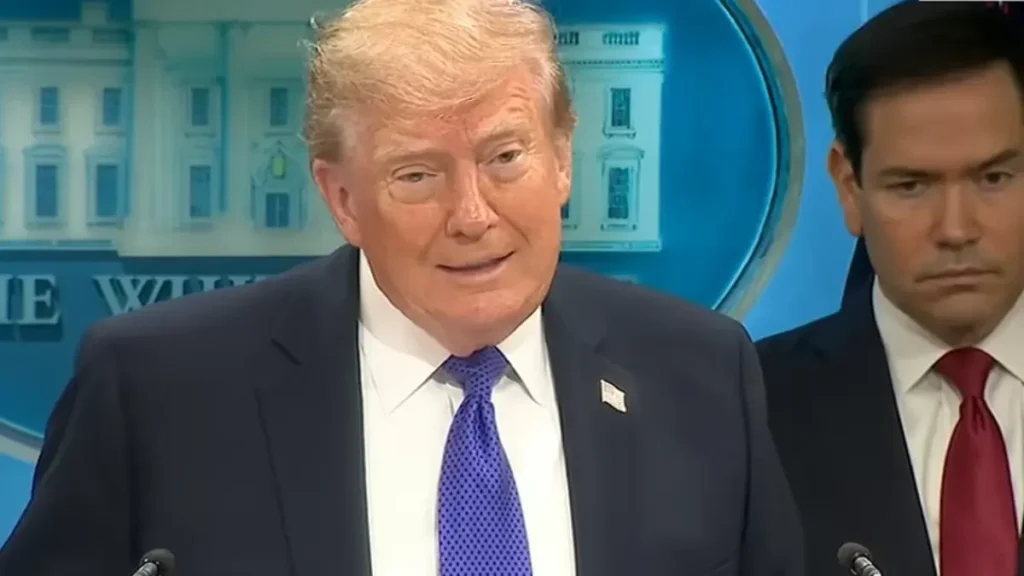
The Trump overseas data center ban is a threat, not yet a policy. On Friday, November 20, 2026, President Donald Trump told reporters that the U.S. will not allow American companies to build AI data centers in other countries, and that firms that try would face a “tremendous tax.” He gave no tax rate, no legal mechanism, and no timeline.
Because data centers are the physical backbone of the AI boom, even a vague statement matters. Here’s a clear, neutral breakdown of the Trump overseas data center ban: what was said, what we don’t know, who could be affected, and the arguments on different sides. For more stories like this, see our AI News & Updates section.
Table of Contents
What Trump Actually Said
Speaking at a White House briefing after returning from Asia, Trump said the country was ahead of China in AI, which he calls “super intelligence,” and that he wouldn’t let China win. According to NBC News, he said American companies won’t be allowed to build data centers outside the U.S., and that those who try would face “tremendous penalties.”
His reasoning, in his words, was that China “will take all of them.” He also singled out Google’s planned investment in Finland. He said some of his own team were hearing about the idea for the first time, which suggests the details haven’t been worked out.
The Big Unknowns Behind the Trump Overseas Data Center Ban
Reporting from several outlets agrees on one thing about the Trump overseas data center ban: much is unclear. According to The Washington Times, it’s not yet clear how the administration would carry out a ban, whether existing overseas facilities would be affected, or whether companies serving foreign customers could get exceptions.
Open questions include:
- The tax: no rate, structure, or start date was given.
- Legal basis: it’s unclear what law or order would be used.
- Existing sites: it’s unknown whether current overseas data centers would be covered.
- Exceptions: nothing was said about data centers built to serve local customers or meet local rules.
- Whether it happens at all: a comment at a briefing is not a signed policy.
Who Could Be Affected by the Trump Overseas Data Center Ban
Large U.S. tech firms operate data centers around the world, so the Trump overseas data center ban could reach many of them. The Washington Times says the proposal could have significant implications for Microsoft, Google, Amazon, and Meta, which run global networks for cloud computing and AI.
Specific examples from the reporting include:
- Google: announced a roughly €13 billion ($15 billion) investment in AI infrastructure in Finland in September. Building work on two of the planned centers was halted last month over concerns about clearing more than 300 hectares of forest, according to the BBC.
- Meta: has broken ground on a data center in Alberta, Canada.
- Anthropic: has signed a long-term agreement to lease a proposed data center in Nova Scotia.
Canada has been pitching itself as an alternative site, partly because of less local pushback so far.
Why the Politics Behind the Trump Overseas Data Center Ban Are So Heated
This announcement didn’t come out of nowhere. Data centers were a central issue in the November 3 midterm elections, with many candidates promising tougher rules on where and how they’re built. Many sit in rural areas, and concerns about noise, water, and electricity use have fueled local opposition. According to Pew Research, there were about 3,000 data centers in the U.S. as of April, with another 1,500 in various stages of approval and construction.
AP reports that a majority of Americans are “extremely” or “very” concerned about data centers’ effect on electricity prices or water supply. Trump, by contrast, argued that communities should “take advantage” of them, suggesting tax breaks, lower utility bills, or direct payments could be part of local deals.
The Arguments on Each Side of the Trump Overseas Data Center Ban
The case for an overseas ban (supporters’ view): Backers argue that keeping AI infrastructure at home keeps jobs, investment, and tax revenue in the U.S., and prevents rivals like China from benefiting from American-built capacity. Trump has also framed it as a way to stay ahead in the AI race.
The case for caution (critics’ view): Skeptics point out that U.S. cloud firms already run foreign data centers to serve local customers and meet data-residency and regulatory rules, so a ban or heavy tax could raise costs, complicate those services, and create uncertainty for companies planning multi-year projects. Others question how it could be enforced, and whether it conflicts with Trump’s own remark that he doesn’t want to “shut off” data centers at home. Separately, local opposition to data centers inside the U.S. remains a major hurdle.
Both sides agree on one fact: data centers are expensive. UBS economists estimate the biggest tech firms could spend as much as $1.8 trillion on AI next year, mostly on data centers.
The Chip Rules That Came Before the Trump Overseas Data Center Ban
The comment followed another announcement earlier in the week. Washington said companies would need a license to buy advanced AI chips, so officials can check that the chips aren’t being used to serve Chinese companies or smuggled into China. According to the BBC, this will affect Southeast Asian countries that have invested heavily in data centers, as Chinese firms look to rent computing power overseas.
Trump contrasted the two ideas, saying foreign production of advanced chips had been “very destructive” to the U.S. while data centers should stay in the country.
What the Trump Overseas Data Center Ban Could Mean for the AI Industry
If a ban or heavy tax ever took effect, it could shift where AI capacity gets built, push more spending into U.S. sites that already face local resistance, and complicate global expansion plans. It could also put more pressure on U.S. power grids. That’s why markets and companies will be watching for details.
This sits alongside other AI-infrastructure stress points we’ve covered, including the huge data center writedown behind the SoftBank $7 billion loss and investor worries after the Alphabet stock crash and AI fears. Want to try AI products yourself? Browse our AI Tools collection.
What to Watch Next on the Trump Overseas Data Center Ban
- Whether the White House issues an executive order or sends a proposal to Congress.
- A defined tax rate or enforcement method.
- Clarity on existing overseas facilities and exceptions.
- Responses from Google, Meta, Microsoft, and Amazon.
- How other countries, such as Finland and Canada, react.
The Bottom Line
The Trump overseas data center ban is, for now, a statement without a plan. It reflects a push to keep AI infrastructure at home, and it lands in the middle of a heated debate over where data centers should go at all. Until there’s a signed order, a tax rate, or a bill, treat it as a signal of direction, not a rule companies must follow.
Sources: BBC, NBC News, AP, The Washington Times, and BigGo Finance reporting, November 20-21, 2026. Details may change as the story develops. This article is for information and is not legal or investment advice.