Microsoft AI Transparency Initiative: Building Enterprise Trust in AI Models and Agents
The Microsoft AI Transparency Initiative is Microsoft’s new effort to make enterprise AI more trustworthy by giving organizations better visibility into how AI models and agents behave. Announced at Microsoft Ignite on November 17, 2026, the initiative brings together more than 40 organizations — including Accenture, Adobe, KPMG, Mastercard, and Volvo Cars — to develop a common, open approach to AI transparency, security, and governance. Microsoft Source
The core idea is simple: as AI agents become more autonomous, organizations need more transparency — not less. Microsoft Source
Table of Contents
Why the Microsoft AI Transparency Initiative Matters
Enterprise AI agents are no longer just chatbots. They connect to company data, tools, credentials, and infrastructure — and they can take actions without human approval at every step. That creates a serious problem: organizations can observe what happens around an AI model, but they often cannot see what happens inside it or independently verify the model’s own account of its behavior. Microsoft Source
This “evidence gap” creates real risks across security, compliance, audit, and accountability. When an AI agent accesses sensitive data, makes a financial transaction, or changes a system, organizations need independent verification — not just the model’s word.
My take: The Microsoft AI Transparency Initiative is not just about compliance. It is about enabling faster AI adoption. When organizations trust that AI behavior is verifiable, they will deploy AI more confidently.
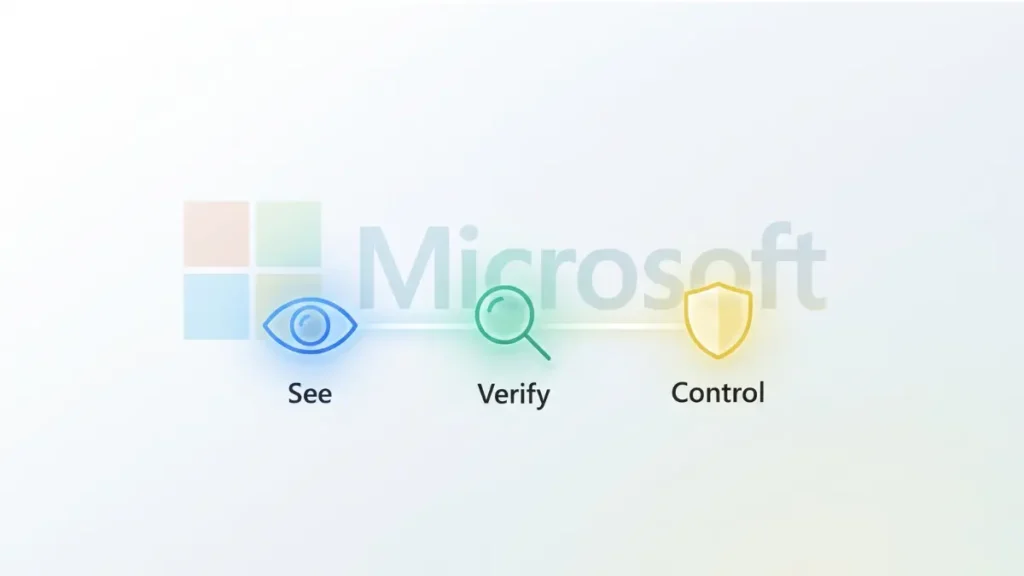
The Three Pillars: See, Verify, Control
Microsoft structured the AI Transparency Initiative around three practical pillars: Microsoft Source
See: Know What AI Is Doing
Organizations should be able to see:
- What the AI was asked and authorized to do
- Which model and runtime were used
- What data and tools it accessed
- What actions it took
Verify: Independently Check AI Behavior
Agents cannot be the sole source of truth about their own behavior. Evidence — agent identity, delegated intent, and actions — should identify its source: the model, the runtime around it, or independent systems like identity and policy. Organizations should be able to verify AI activity using their own security and compliance systems, without relying only on the model provider’s account. Microsoft Source
Control: Stay in Charge of AI Actions
Organizations should retain control over:
- What data their agents can access
- What actions are permitted
- Where the evidence lives (with the organization, not the provider)
My take: This framework is practical. “Trust the model” is not a control — evidence-based governance is.
Who Is Involved in the Microsoft AI Transparency Initiative?
More than 40 organizations are part of the Microsoft AI Transparency Initiative, including: Microsoft Source
- Accenture
- Adobe
- KPMG
- Mastercard
- Volvo Cars
Microsoft is also expanding its participation in NIST’s SI Agent Standards Initiative to develop open, industry-wide standards for AI transparency, security, and governance. Microsoft Source
My take: Cross-industry collaboration matters here. This is not just Microsoft’s initiative — the whole ecosystem is shaping it.
How the Microsoft AI Transparency Initiative Integrates with Microsoft Products
Microsoft will incorporate this work into Microsoft AI, Microsoft Foundry, and Microsoft Copilot — enabling customers to use the resulting evidence with their security and compliance tools, whether from Microsoft or other providers. Microsoft Source
My take: This is the practical step. Standards will not just live on paper — they will be integrated into real products.
What the Microsoft AI Transparency Initiative Means for Enterprises
For enterprises, the Microsoft AI Transparency Initiative means:
- AI agents can be deployed with transparency and verification built in
- Compliance and audit become easier
- Model/provider switching will not break governance
- Security teams get better visibility
My take: This is especially important for organizations in regulated industries — finance, healthcare, legal — where accountability is non-negotiable.
Internal Links (Your Site)
- Google’s October 2026 AI Updates — for context on the broader AI innovation landscape
- Best AI Invoicing Tools for Freelancers — for AI adoption in business workflows
- AI for Freelancers — for AI governance and trust in practice
External Links (Authoritative Sources)
- Microsoft Source – AI Transparency Initiative — official announcement
- Microsoft Security Blog – Ignite 2026 — deeper technical details
- Microsoft – Learn More AI Transparency — to follow the initiative’s progress
FAQ
Q: Is the Microsoft AI Transparency Initiative only for Microsoft?
A: No — more than 40 organizations (Accenture, Adobe, KPMG, Mastercard, Volvo Cars) are involved, and it is developing open, industry-wide standards. Microsoft Source
Q: Will the Microsoft AI Transparency Initiative slow down AI agents?
A: No — the goal is to make AI adoption faster and safer, with transparency and verification built in. Microsoft Source
Q: Will the Microsoft AI Transparency Initiative work with open-source models?
A: Yes — the initiative is designed to work across both closed and open-weight models. Microsoft Source
Q: When will Microsoft AI Transparency Initiative standards be available?
A: It is still in the pre-release phase — Microsoft is working with NIST to develop standards and will integrate them into products. Microsoft Source
Conclusion: Why the Microsoft AI Transparency Initiative Matters
The Microsoft AI Transparency Initiative is an important step toward making enterprise AI adoption safer and more trustworthy. When organizations can independently verify AI behavior, they can innovate faster — without compromising security or compliance.