
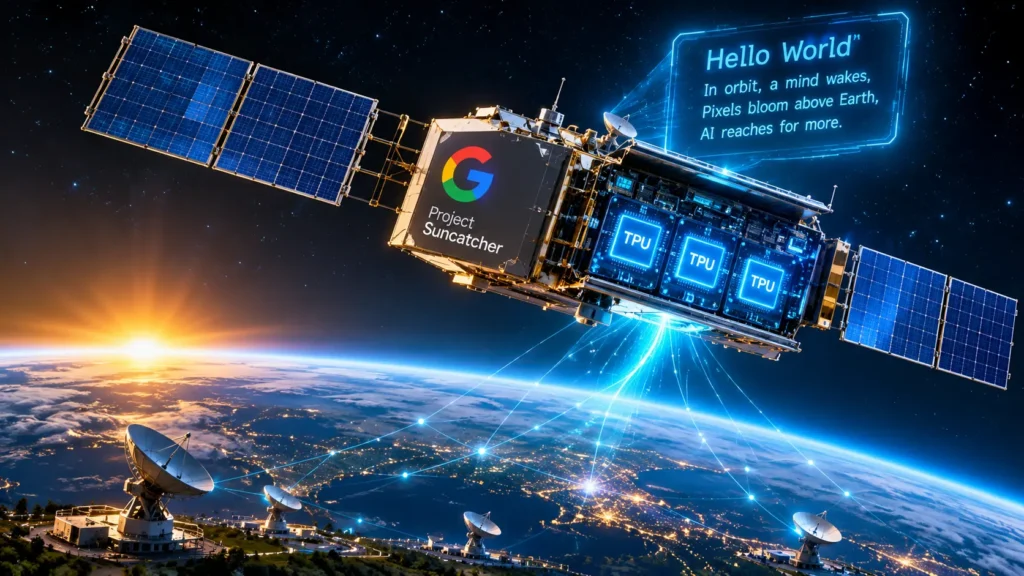
Google Project Suncatcher TPU Satellite: 5 Powerful Milestones in Space AI (2026)
Quick Answer: Google Project Suncatcher TPU satellite has achieved its “Hello World” milestone—the first-ever AI response from a data centre-class TPU in orbit. Launched on October 1, 2026, the prototype satellite ran Google’s Gemma 4 open model in space and generated a haiku about being in orbit. The mission is exploring whether space could one day host scalable AI compute infrastructure, with twin interconnected satellites planned for 2027.
AI is usually something that lives in data centers on Earth — rows of servers humming away in climate-controlled buildings. But Google is now asking a very different question: what if AI compute could live in space?
That is the idea behind Project Suncatcher, Google Research’s long-term moonshot to explore powering AI compute in orbit. And this week, the project hit a major milestone: for the first time, a data-center-class TPU in space generated an AI response.
For more AI updates like this, explore our AI News & Updates section.
Here’s what happened, why it matters, and what comes next for Google’s space-based AI ambitions.
Table of Contents
What Is Google Project Suncatcher TPU Satellite?
Project Suncatcher is Google Research’s effort to explore whether space could one day host scalable machine learning infrastructure. The idea is simple but ambitious: instead of building ever-larger data centers on Earth, could AI compute eventually run in orbit?
The Google Project Suncatcher TPU satellite launched on October 1, 2026, aboard SpaceX’s Transporter-18 rideshare mission. It was built in partnership with Planet, a company known for its Earth-imaging satellite fleet.
The satellite carries TPU trays — the same family of chips Google uses to power AI workloads on Earth. The goal is to test how these chips handle the harsh realities of space: radiation, thermal extremes, and the physical stress of launch.
Google also published a peer-reviewed paper in Joule detailing the research behind the mission.
In short, the Google Project Suncatcher TPU satellite is Google’s first real-world test of whether AI hardware can survive and function in orbit.
The “Hello World” Milestone: First AI Response From Orbit
This week, Google announced that its Project Suncatcher TPU satellite reached its “Hello World” milestone — the first-ever AI response generated by a data-center-class TPU in orbit.
During a ground-station pass, Google uplinked a prompt to the satellite’s onboard Gemma 4 open model, asking it to write a haiku about being in space. As the satellite passed over Svalbard, Norway, the downlinked response confirmed success:
Blue marble below
Data streams in silent grace
Starlight feeds my core. ✨
This may sound like a small achievement, but it is a significant one. It proves that a TPU — hardware designed for Earth-based data centers — can successfully run an AI model in the extreme environment of space.
Following the haiku, the team tested space-themed limericks and telemetry prompts that reported the technical status of the payload systems.
This milestone proves that the Google Project Suncatcher TPU satellite can run an AI model in the harsh environment of space.
Google Project Suncatcher TPU Satellite: 5 Powerful Milestones
1. Launch Into Orbit (October 1, 2026)
The first milestone was simply getting there. The Google Project Suncatcher TPU satellite launched aboard SpaceX’s Transporter-18 rideshare mission, built in partnership with Planet.
Google confirmed contact with the satellite shortly after launch, and it has been operating as expected since.
The launch of the Google Project Suncatcher TPU satellite marked the first step in Google’s long-term space AI moonshot.
2. Commissioning and Early ML Tests
Over the following weeks, Google completed its commissioning checklist, which included:
- Powering up the host and TPU trays
- Running early machine learning tests
- Verifying basic systems in orbit
These early checks confirmed that the Google Project Suncatcher TPU satellite was functioning as intended in orbit.
3. First AI Response From a TPU in Orbit
The “Hello World” milestone — a haiku generated by Gemma 4 on an orbiting TPU — is the project’s most visible achievement so far.
It marks the first time a data-center-class TPU has produced an AI response in space.
The haiku response is the most visible achievement of the Google Project Suncatcher TPU satellite so far.
4. Testing TPUs Under Space Conditions
Next, Google will run a series of tests to evaluate how the TPUs perform under:
- Thermal stress — extreme temperature swings in orbit
- Radiation exposure — cosmic radiation that can damage electronics
- Physical stress — the forces experienced during launch and orbit
These tests will determine whether the Google Project Suncatcher TPU satellite can reliably handle AI workloads over time.
5. Twin Interconnected Satellites in 2027
The next major milestone is already planned: twin interconnected satellites in 2027.
This will test whether multiple satellites can work together as a network — a key step toward the idea of space-based AI compute at scale.
Twin interconnected satellites are the next major step for the Google Project Suncatcher TPU satellite program.
Why Put AI Compute in Space?
It may sound like science fiction, but there are real reasons behind the idea.
Unlimited solar power: In orbit, satellites have near-continuous access to sunlight — no clouds, no night, no weather. This could theoretically provide more consistent power for energy-hungry AI workloads.
No cooling constraints: Space is cold, which could reduce the massive cooling costs that Earth-based data centers face.
Scalability: If AI demand keeps growing, Earth-based data centers may face limits on land, power, and water. Space offers a different kind of frontier.
Reduced Earth impact: Moving some compute off-planet could reduce the strain on Earth’s power grids and water resources.
Of course, there are huge challenges too: launch costs, radiation damage, maintenance, and the sheer difficulty of operating hardware in space. That is exactly what Project Suncatcher is designed to test.
That is exactly the question the Google Project Suncatcher TPU satellite is designed to answer.
What Is Gemma 4?
Gemma 4 is Google’s open model that ran on the orbiting TPU. It is part of Google’s Gemma family of open-weight models, designed to be lightweight and adaptable.
The fact that a Gemma model — not a massive frontier model — was used for the first test makes sense: it is smaller, more efficient, and better suited to the limited compute available on a prototype satellite.
Gemma 4 was the natural choice for the Google Project Suncatcher TPU satellite because it is lightweight and efficient enough for a prototype mission.
As the project matures, Google may test larger models in orbit.
What Comes Next for the Google Project Suncatcher TPU Satellite?
Google has laid out a clear roadmap:
- Now–2026 end: Continue TPU testing under thermal stress and radiation exposure
- 2027: Launch twin interconnected satellites
- Long term: Explore whether space-based AI compute can scale
Google describes this as a “cosmic moonshot” — a long-term bet that may take years to prove out. But the “Hello World” milestone shows the basic concept works: AI chips can run in space.
The road ahead for the Google Project Suncatcher TPU satellite is long, but the first milestone is already behind it.
Why This Matters for the AI Industry
If Project Suncatcher succeeds, it could change how the AI industry thinks about compute infrastructure.
Today, AI companies are locked in a race to build bigger data centers on Earth — consuming enormous amounts of power and water. Space-based compute could offer an alternative path, though it is still very early.
For now, the Google Project Suncatcher TPU satellite is a research experiment, not a replacement for Earth-based data centers.
But the direction is clear, and Google is not the only company thinking about it.
As AI demand grows, expect more companies to look upward.
Key Facts Summary
| Detail | Update |
|---|---|
| Project name | Project Suncatcher |
| Run by | Google Research, in partnership with Planet |
| Launch date | October 1, 2026 |
| Launch vehicle | SpaceX Transporter-18 rideshare |
| First AI response | Haiku generated by Gemma 4 in orbit |
| Milestone | “Hello World” — first AI response from a data-center-class TPU in orbit |
| Mission | Google Project Suncatcher TPU satellite — first AI response in orbit |
| Next tests | Thermal stress and radiation exposure |
| Next milestone | Twin interconnected satellites in 2027 |
| Research paper | Published in Joule |
Frequently Asked Questions
What is Google Project Suncatcher TPU satellite?
Project Suncatcher is Google Research’s long-term moonshot to explore whether space could one day host scalable AI compute infrastructure. Its first prototype satellite launched on October 1, 2026.
What did the Google Project Suncatcher TPU satellite achieve?
It achieved the “Hello World” milestone: the first-ever AI response generated by a data-center-class TPU in orbit. The satellite’s onboard Gemma 4 model generated a haiku about being in space.
What is a TPU?
A TPU (Tensor Processing Unit) is Google’s custom chip designed for AI workloads. Project Suncatcher is testing whether these chips can run reliably in the harsh environment of space.
When will twin satellites launch?
Google plans to launch twin interconnected satellites in 2027 as the next major milestone of Project Suncatcher.
Could AI really run in space?
That is what Project Suncatcher is testing. Early results are promising — a TPU successfully ran an AI model in orbit — but scaling this to replace Earth-based data centers is still a long-term goal.
Sources and Further Reading
- Google Blog — “We’ve received our first response from the Project Suncatcher prototype satellite”: The official announcement of the “Hello World” milestone.
- Google Blog — “Our Project Suncatcher prototype satellite is in orbit”: The original launch announcement from October 1, 2026.
- Google Research: More on Google’s AI and space research.
Editorial note: Project Suncatcher is an early-stage research moonshot. Timelines and technical details may change as the mission progresses.


Pingback: Google AI News October 2026: 11 Big Updates, From Gemini 4 to Quantum Computing -