Nestle Water Business Spin-Off: 7 Major Facts Explained (2026)
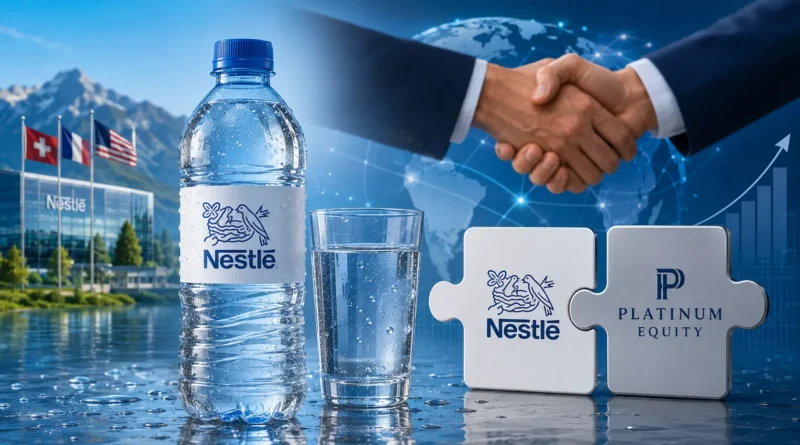
Nestle water business spin-off news became official on July 23, 2026, when the Swiss food giant confirmed it is combining its waters and premium beverages division with U.S. investment firm Platinum Equity. The move is expected to raise roughly €3 billion ($3.43 billion) for Nestle and is a rare, fast-moving decision for a company that typically takes years to restructure a division this size.
Nestle is not walking away from the water category entirely. As part of the Nestle water business spin-off structure, the company is keeping a 50% stake in the new venture and bringing in an experienced operating partner instead of selling outright.
Fact-checked July 27, 2026 against Nestle’s official press release, Platinum Equity’s newsroom statement, and Reuters’ coverage.
For more coverage like this, see our latest Business & Economy news.
Table of Contents
The New Company Behind the Nestle Water Business Spin-Off: Peranel
The Nestle water business spin-off centers on a new joint venture called Peranel, headquartered in Paris. It starts life as a sizable business in its own right: more than 30 brands sold in around 120 countries.
That portfolio includes Source Perrier, S.Pellegrino, Acqua Panna, and the Nestle Pure Life business, plus a long tail of smaller regional water brands that are household names in their local markets but unknown outside them.
Peranel is not just inheriting bottling plants and brand names. According to Nestle’s official announcement, the business comes with its own in-house R&D team, one that has driven approximately 120 product launches since 2022. That is a meaningful detail for anyone assessing the long-term strength of this Nestle water business spin-off — it signals real innovation capacity, not just legacy shelf space.
Leadership continuity is part of the plan. Muriel Lienau, who currently leads Nestle’s waters and premium beverages unit, will stay on to run Peranel once it operates independently. In the official statement, she called the announcement an important milestone for her team and said she was glad to have Platinum Equity on board for what comes next.
What the Nestle Water Business Spin-Off Deal Is Worth
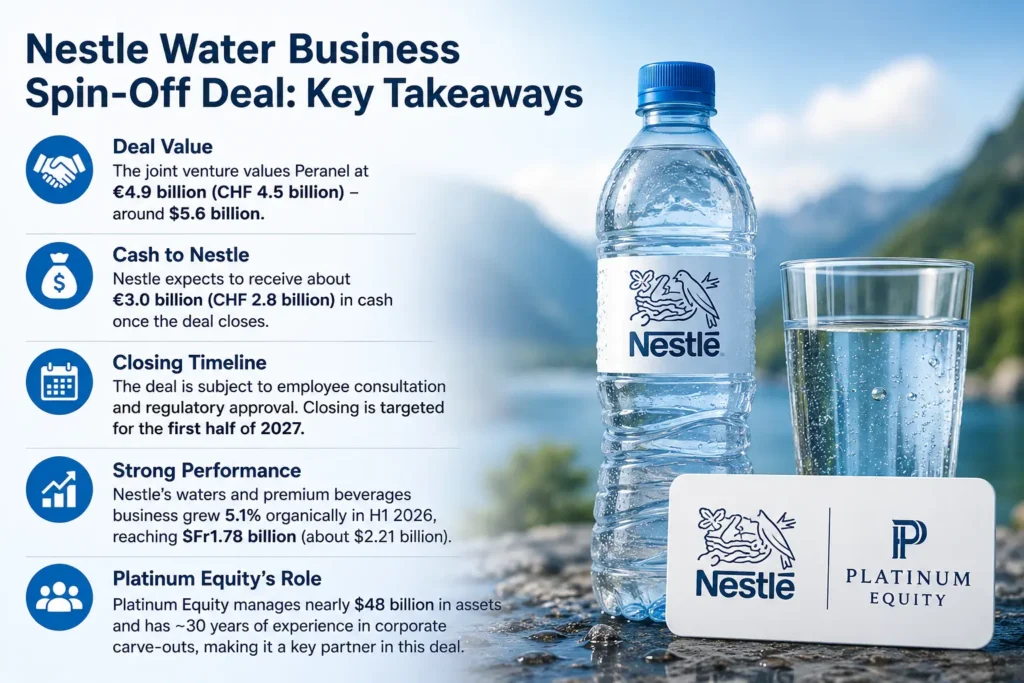
The joint venture assigns Peranel an enterprise value of €4.9 billion (CHF 4.5 billion), or roughly $5.6 billion. Nestle expects to receive around €3.0 billion (CHF 2.8 billion) in cash once the deal closes.
That payout is not immediate. The transaction still needs to clear employee consultation and regulatory approval, and both companies are targeting the first half of 2027 for closing — later than some early reports assumed.
It is worth noting this is not a struggling unit being cut loose. Nestle’s waters and premium beverages business grew sales 5.1% organically in the first half of 2026, reaching SFr1.78 billion (about $2.21 billion). By that measure, it is one of the faster-growing parts of the company right now.
Platinum Equity brings scale of its own to the table. The firm manages close to $48 billion in assets and has roughly three decades of experience handling corporate carve-outs, according to the joint announcement. That track record appears to be a key reason Nestle chose a partnership structure for its water business spin-off over an outright sale.
Why Nestle Is Doing This Now
The Nestle water business spin-off fits into the broader strategy CEO Philipp Navratil has pursued since taking the top job in 2025. He has pushed to sharpen the company’s focus on its largest categories — infant formula, coffee, and pet food — rather than continuing to manage a capital-intensive water division alongside everything else.
Navratil framed the partnership as a way to help Peranel move with greater agility while continuing to invest in innovation, premiumization, and sustainability. Platinum Equity’s leadership struck a similar note: Co-President Louis Samson pointed to the firm’s operational expertise and experience building standalone companies, while Managing Director Igor Chacartegui described Peranel’s brand portfolio as one that global consumers already know and trust, adding that the firm plans to support organic growth and pursue further M&A to strengthen it.
The Problem This Nestle Water Business Spin-Off Also Solves
Nestle’s water business has had a rough few years. In France, it has faced regulatory backlash over unauthorized water treatment methods. Combine that with broader environmental criticism around water extraction and sustainability, and the division has generated headlines for the wrong reasons.
Spinning it off does not erase those issues. But it does mean Peranel will manage them as an independent company, without every legal dispute in France becoming a Nestle headline by association.
[INTERNAL LINK →] Curious how other global brands are restructuring this year? Check out our recent corporate news coverage.
What’s Next for Peranel After the Nestle Water Business Spin-Off
Nestle announced the deal alongside its first-half 2026 earnings on July 23, filed as an ad hoc disclosure under Swiss stock exchange rules (Art. 53 LR). Industry analysts are reading it as a signal that even the largest food and beverage companies are willing to carve out specialist units when a focused operator can plausibly grow a brand faster than a diversified conglomerate can.
Nothing changes operationally until the deal closes. From here, two things are worth watching: regulatory clearance in the EU, and how much Peranel discloses about its investment plans once it starts operating on its own.
Bottom Line on the Nestle Water Business Spin-Off
This Nestle water business spin-off is not Nestle quietly offloading a problem. It is a bet that Perrier, S.Pellegrino, and Nestle Pure Life will grow faster under a focused operator than as one division inside a much larger company. Nestle keeps half the upside, banks close to €3 billion in cash, and frees up management attention for coffee, pet food, and infant nutrition.
Platinum Equity, meanwhile, gets to apply its carve-out playbook — backed by roughly $48 billion in assets under management — to a globally recognized brand portfolio with an R&D engine that has already delivered around 120 launches since 2022. Whether this Nestle water business spin-off pays off will depend heavily on how quickly Peranel can move past its regulatory issues in France.